Reskilling for the Future: AI didn't create the problem - it revealed a reskilling problem (or opportunity)
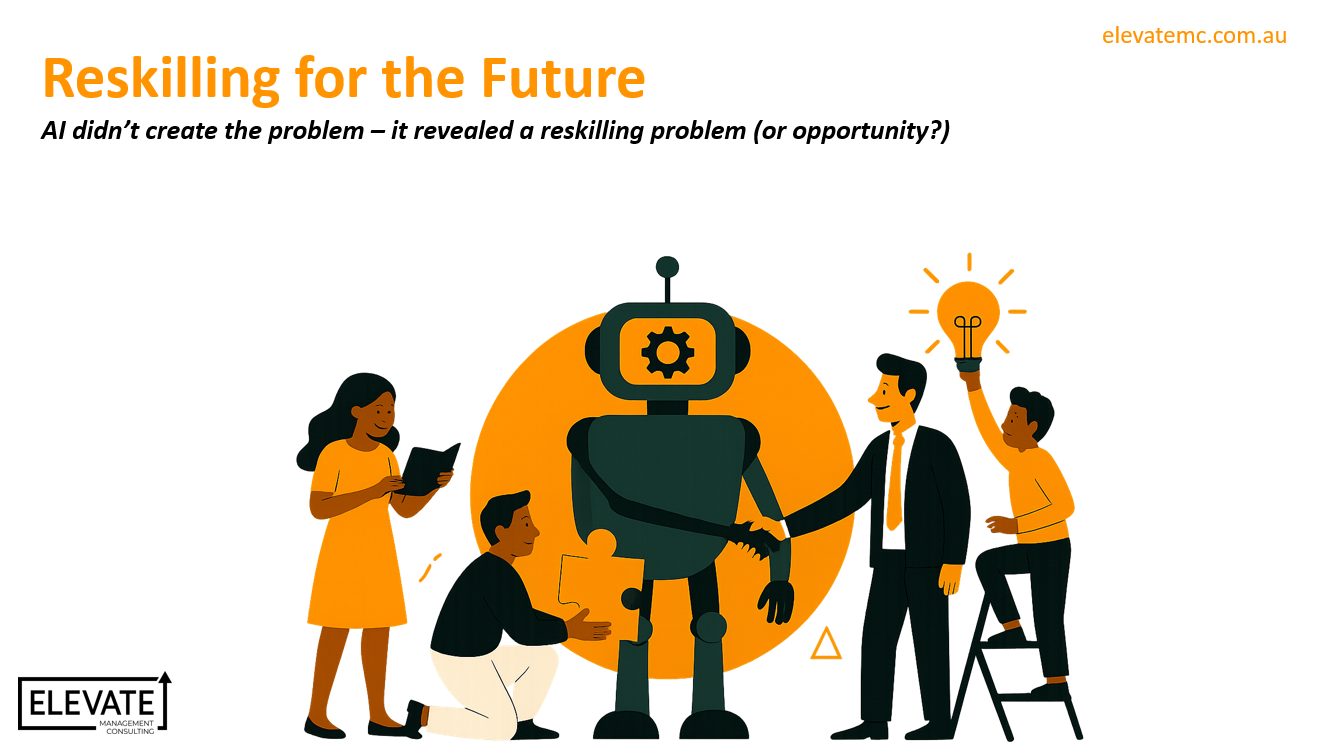
There’s been a lot written about AI, automation, and the need to reskill people – and for good reason because the scale of this change is hard to ignore.
But I’ve been thinking a lot about the reskilling part and wondering whether we’re focusing too much on building new skills, and not enough on what might be quietly eroding in the process – our critical thinking ability– to think, decide, apply judgement in the first place, and particularly in a much more uncertain, complex, world.
And somewhat ironically, much of the current research suggests these are becoming some of the most valuable capabilities organisations can build — from the World Economic Forum, University of Sydney 2026 Skills Horizon, and Microsoft to name a few.
Reskilling isn’t new – but something is different now
But reskilling isn’t new, as industries and technology evolve, people have always had to adapt, learn new skills, and move roles.
What’s different now is the pace and continuity of change.
Work no longer shifts in clear phases where people can step out, learn, and step back in. It is being continuously reshaped while people are still in it. That breaks an old assumption in most learning systems: that there is time to “catchup” between waves of change.
AI hasn’t created a learning ‘problem’ – it has exposed one that’s not been solved
We’ve known for a long time that most learning doesn’t happen in formal training.The 70/20/10model has been around for decades, with a simple idea: most capability is built through experience, not courses.
But organisations have always struggled to design for that 70.
Companies everywhere invest heavily in formal learning (the 10) because it’s visible and easy to scale. Coaching and mentoring (the 20) exist in pockets. But the 70 –the learning that happens through real work, has often been left to chance, or it’s naturally been happening, but we’ve not been good at designing for it and measuring it.
AI is now exposing that gap. As work becomes even more dynamic, the separation between ‘work’ and ‘learning’ is breaking down, forcing or creating the opportunity to redesign learning directly into work itself, rather than around it.
To add to the problem: organisation designs weren’t built for continuous learning
And to add to this, most organisations are still designed around stable roles and predictable development cycles: defined job descriptions, capability frameworks, career pathways, and training interventions when gaps appear.
That model works when change is episodic. But AI-enabled work changes continuously, with people often expected to work in new ways before those ways are fully defined.
Asa result, reskilling becomes reactive, always slightly behind the work itself.That’s not just a learning issue; it’s a structural one.
The shift: we no longer have the luxury of separating learning from work
For years, we’ve used technology to optimise work. The next shift is using it to develop people through work.
That might look like
- AI that explains why a recommendation was mad
- Workflows where AI prompts reflection, judgement, consideration (rather passive AI use) – which there are already AI tools available that’s been designed to strengthen this.
- Roles that keep humans engaged in judgement, not just execution.
So that work becomes the place where capability is built – not something separate from it, as we’ve always intended for learning and development.
The subtle risk: we can lose practice in thinking
A quieter risk is emerging with AI: not that people stop working, but that they stop practising judgement (because it’s easier to accept outputs rather than question them).
AI is increasingly automating tasks, like drafting presentations, summarising information, structuring arguments. But this work was never just ‘administrative’, but developmental. They were developmental experiences that helped people build judgement over time through repetition, reflection, ambiguity and problem-solving.
AsAI takes on more of these cognitive layers, people may still produce polished outputs without fully developing the underlying judgement that historically came from doing the work themselves. Even experienced professionals with well-developed judgement skills are not ‘immune’. AI can encourage cognitive offloading – reducing how often people deeply engage with problems, sit with ambiguity or independently form ideas.
Ironically, the friction AI removes may have been one of the very things that helped build our expertise in the first place.
Designing reskilling takes a considered approach
This is why reskilling can’t just be about teaching people to use AI tools or simply integrating AI into work and roles. It also requires designing work in ways that continue to build the human skills that matter.
The opportunity isn’t simply to reskill people for new tools, but to finally design work so capability is continuously developed within it.
If we don’t do that intentionally, we risk not only skill gaps but quietly designing out judgement and critical thinking at the very moment they matter most.
- Create AI workflows to use it as a learning tool (built into the flow of work), not only as a productivity tool.
- Redesign roles, workflows that keep the "human in the loop" parts that matter.
- Be deliberate with designing the human governance, critical judgement in how to challenge, or review the AI outputs.
- Develop recognition/rewards and measures for judgement, critical thinking.
These are fascinating times, and I’m excited to be part of the conversation about how we thoughtfully shape work, learning, and human capability for the future.
More articles
Reskilling for the Future: AI didn't create the problem - it revealed a reskilling problem (or opportunity)
Newsletter - June 2026
Newsletter - May 2026
Using Technology to Drive Smarter Outcomes
Newsletter - April 2026
Newsletter - March 2026

Newsletter – February 2026
Building the Blueprint before laying the Bricks
Elevate Management Consulting: How we deliver with you?
Business Transformation with Elevate
Elevate's Perspective: Why smart leaders ask for help

Let’s talk about how we can support your organisation.
We’ll walk you through our delivery process, share examples of past projects, and explore tailored solutions to the challenges you’re facing.